
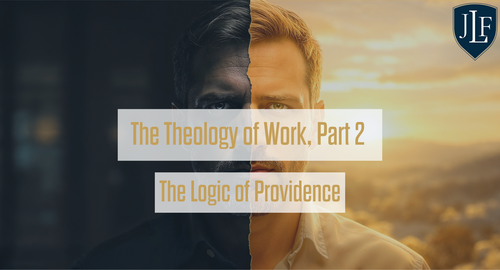
The Theology of Work, Part 2 The Logic of Providence
Leading Others When You Feel Unsupported
Leadership in the professional world often feels like a high-wire act performed without a net. You are expected to be the source of vision, the arbiter of conflict, and the pillar of stability. When the system fails or the support evaporates, we often default to a frantic, self-reliant fortitude.
But fortitude built on self is a brittle shield. What you need is not more “grit,” but a deeper “Grip”—that is to say the grip of Divine Providence.
The Inadequacy of Man: The Myth of the “Lonesome Leader”
The world tells you that “it’s lonely at the top.” This is a half-truth that leads to burnout. It is only lonely at the top if you believe you are the one holding the mountain together. When you feel unsupported by your superiors, your board, or your peers, you begin to operate out of a “scarcity mindset.” You stop leading out of a desire for excellence and start leading out of a fear of exposure.
You feel like an imposter because you are trying to exert a level of control that no human being was ever designed to possess.
The Sovereignty of God: The Intellectual Framework of Providence
In his Systematic Theology, Joel Beeke defines Providence as “that continued exercise of the divine energy... whereby the Creator preserves all His creatures... and directs them to their appointed end.”
This is the “War Map” for your leadership. Providence means that there are no “accidental” budget cuts, no “random” HR crises, and no “unforeseen” market shifts in the eyes of God.
The ESV Expository Commentary on Romans 8:28 notes that the “good” that God works toward is not always your professional comfort, but your Christ-like character and His ultimate glory. For the professional or the '“pull yourself up by the bootstraps” individual, this is a massive intellectual relief. It means your responsibility is faithfulness, while God’s responsibility is outcomes.
The Mindset Shift: The Psychological Security of Providence
If God is sovereign over the macro (the universe) and the micro (your specific workplace insecurities), then your security is “ex-centric”—it exists outside of yourself.
Think of it this way: If you were “elected” to your position by God’s decree before the foundation of the world, then no earthly lack of support can unseat His purpose for you. John Piper put it this way: “God is most glorified in your leadership when you are most satisfied in His sovereignty, especially when the earthly pillars are crumbling.”
When you feel unsupported, you aren’t being abandoned; you are being invited to stop leaning on broken reeds and start leaning on the Rock.
The War Map for this week: When you feel the weight of leadership today, shift the burden. Tell yourself: “The outcome of this meeting/case/surgery does not rest on my sovereignty, but on His. I will be precise, I will be diligent, but I will not be anxious. I am a steward, not the Owner.”
Leadership in the professional world often feels like a high-wire act performed without a net. You are expected to be the source of vision, the arbiter of conflict, and the pillar of stability. When the system fails or the support evaporates, we often default to a frantic, self-reliant fortitude.
But fortitude built on self is a brittle shield. What you need is not more “grit,” but a deeper “Grip”—that is to say the grip of Divine Providence.
The Inadequacy of Man: The Myth of the “Lonesome Leader”
The world tells you that “it’s lonely at the top.” This is a half-truth that leads to burnout. It is only lonely at the top if you believe you are the one holding the mountain together. When you feel unsupported by your superiors, your board, or your peers, you begin to operate out of a “scarcity mindset.” You stop leading out of a desire for excellence and start leading out of a fear of exposure.
You feel like an imposter because you are trying to exert a level of control that no human being was ever designed to possess.
The Sovereignty of God: The Intellectual Framework of Providence
In his Systematic Theology, Joel Beeke defines Providence as “that continued exercise of the divine energy... whereby the Creator preserves all His creatures... and directs them to their appointed end.”
This is the “War Map” for your leadership. Providence means that there are no “accidental” budget cuts, no “random” HR crises, and no “unforeseen” market shifts in the eyes of God.
The ESV Expository Commentary on Romans 8:28 notes that the “good” that God works toward is not always your professional comfort, but your Christ-like character and His ultimate glory. For the professional or the '“pull yourself up by the bootstraps” individual, this is a massive intellectual relief. It means your responsibility is faithfulness, while God’s responsibility is outcomes.
The Mindset Shift: The Psychological Security of Providence
If God is sovereign over the macro (the universe) and the micro (your specific workplace insecurities), then your security is “ex-centric”—it exists outside of yourself.
Think of it this way: If you were “elected” to your position by God’s decree before the foundation of the world, then no earthly lack of support can unseat His purpose for you. John Piper put it this way: “God is most glorified in your leadership when you are most satisfied in His sovereignty, especially when the earthly pillars are crumbling.”
When you feel unsupported, you aren’t being abandoned; you are being invited to stop leaning on broken reeds and start leaning on the Rock.
The War Map for this week: When you feel the weight of leadership today, shift the burden. Tell yourself: “The outcome of this meeting/case/surgery does not rest on my sovereignty, but on His. I will be precise, I will be diligent, but I will not be anxious. I am a steward, not the Owner.”
Recent
It's Been a Heavy Week in Meigs County
September 26th, 2026
The Church Does Not Belong To Us
July 1st, 2026
The Pursuit of Joy Is Not Optional
May 14th, 2026
The Theology of Work, Part 2 The Logic of Providence
May 7th, 2026
The Debt That Never Expires: Living a Life of Unconditional Love
May 4th, 2026
Archive
2026
February
March
May
No Comments